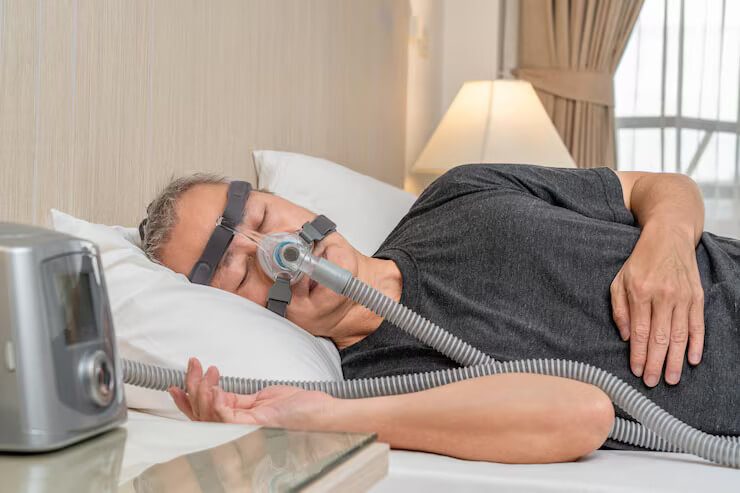
Sleep apnea is a breathing disorder that causes sufferers to experience repeated breathing pauses during sleep. These pauses last about 10–30 seconds and can recur up to 50 times per hour. As a result, people with sleep apnea do not get enough rest, feel tired, are excessively sleepy, and are prone to various diseases.
The onset of sleep apnea is caused by several factors, one of the most common being obstructive sleep apnea (OSA). OSA occurs due to a narrowing of the airway muscles that closes the airway and blocks the entry of air, causing breathing to stop.
Sleep apnea can be addressed in several ways depending on its severity and cause. Generally, the gold standard in treating sleep apnea is PAP therapy (positive airway pressure).
Featured Product
ResMed AirSense 10 Autoset
ResMed's best automatic CPAP — adjusts pressure with every breath for precise, comfortable therapy all night long.
View Product Free ConsultationPAP therapy works by delivering air at a certain pressure to keep the airway open during sleep. The amount and type of pressure delivered vary depending on the patient's needs, the doctor's recommendation, and the type of therapy device used.
There are three types of PAP therapy devices: CPAP, APAP, and BPAP. Curious about their differences and which type of therapy is best? Let's look at the differences between CPAP, APAP, and BPAP you need to know below.
What Is CPAP?
Continuous positive airway pressure (CPAP) is a type of therapy that delivers constant air pressure throughout the night. For example, you receive a prescribed air pressure of 15 cmH2O from your doctor. The CPAP device will then deliver air pressure at that level, kept the same all night.
Our Services for You
Although CPAP is the most common and simplest therapy mode, this type of therapy tends to be less comfortable, especially for new patients. This is because CPAP's delivery of constant air pressure does not account for inhaling and exhaling.
When you inhale, the air pressure may not feel disruptive because it is in the same direction as the air you breathe in. However, when you exhale, the strong push of air can cause a fairly disruptive feeling of discomfort.
CPAP is usually given to people with sleep apnea severe cases who need constant pressure support during sleep. Any discomfort that arises can be addressed by lowering the pressure level or switching to another type of therapy device such as APAP or BPAP.
What Is APAP?
Automatic positive airway pressure (APAP) is a therapy machine that can automatically adjust air pressure based on the patient's needs. This means the air pressure delivered can rise or fall according to the degree of the patient's airway closure.
When a person with sleep apnea falls asleep, the airway does not immediately close completely but narrows first. The APAP machine delivers only as much air pressure as is needed to reopen the airway.
The air pressure needed to open a narrowing is smaller than that needed for a fully closed airway, and vice versa. This makes the pressure delivered more precise and not excessive, so the patient feels more comfortable and the therapy is more optimal.
However, like CPAP, APAP also uses only one pressure, so new patients still need to adapt. But don't worry — you can use an APAP machine equipped with EPR, auto ramp dan soft pressure like the ResMed AirSense 10 Autoset. These features adjust the pressure to be gentler and make you feel more comfortable.
What Is BPAP?
Bilevel positive airway pressure (BPAP) is a therapy machine that delivers two different air pressures as the patient inhales and exhales. Although it has the same form, BPAP has more advanced functions and features than CPAP.
BPAP is designed to deliver higher air pressure during inhalation to keep the airway open. Then the machine delivers lower air pressure during exhalation, so the push of air is gentler and breathing is more comfortable.
Not only that, BPAP is also more appropriate for people with sleep apnea accompanied by lung disease, because it has settings that support the breathing cycle. So it not only helps open the airway but also keeps the respiratory system from collapse.
So if you are diagnosed with sleep apnea a severe case along with a history of respiratory disease, your doctor may recommend that you use BPAP. The ResMed AirCurve 10 VAuto is the best BPAP machine you can rely on for effective, comfortable therapy.
CPAP, APAP, BPAP — Which to Choose?
After understanding the differences between CPAP, APAP, and BPAP, you may wonder which type of therapy is best for me? This is a fairly common and frequently asked question, but the answer cannot be determined so easily.
A PAP therapy machine is a medical device used to support the treatment of sleep apnea. Therefore, it cannot be used carelessly and must be accompanied by monitoring from a doctor or professional healthcare worker.
In terms of features and technology, it is clear that BPAP is the best machine within the scope of sleep apneatherapy. Even so, that does not mean you must use a BPAP machine just because of its capable functions and features. You may have different needs.
If you have sleep apnea and need an air-pressure mechanism to open the airway, have no history of respiratory disease, and can adapt to the pressure delivered, then an APAP machine alone is actually enough to meet your needs.
So if you are currently looking for a machine for sleep apneatherapy, you can weigh your options in terms of needs, comfort, and the budget you have. You can also consult a doctor first to make your decision.
Conclusion
The difference between CPAP, APAP, and BPAP lies in the air-pressure system delivered. But that's not all — there are now many additional features that distinguish one machine from another. If you want to see the kinds and types of ResMed PAP therapy devices, you can contact Resindo Medika.
Resindo Medika is the official distributor of ResMed and Somnomedics in Indonesia. You can browse the online catalog or come directly to the Resindo Medika office to consult, get further explanation about the device's functions and features, and see a live demo of PAP therapy devices.
That's all the information about the differences between CPAP, APAP, and BPAP you should know. We hope it helps!
Source:
Healthline: Differences Between CPAP, APAP, and BiPAP as Obstructive Sleep Apnea Therapies. Accessed in 2022
AAST The Community for Sleep-Care Professional: BiPAP™ (Bilevel positive airway pressure) or CPAP Therapy?. Accessed in 2022