Smartwatches and fitness trackers are becoming increasingly sophisticated at monitoring sleep—some even claim to detect sleep apnea. However, data from a smartwatch CANNOT replace a medical sleep study for diagnosing sleep apnea. This article explains why, and when you still need a professional evaluation.
Why Migraines Happen
What Can a Smartwatch Measure?
Modern smartwatches can track:
Featured Products
ResMed AirSense 10 Autoset
ResMed's best auto-adjusting CPAP — adapts pressure with every breath for precise, comfortable therapy throughout the night.
View Product Free ConsultationSleep duration: How long you sleep
Sleep stages: Estimated REM, deep sleep, and light sleep (based on movement and heart rate)
Heart rate variability (HRV)
Blood oxygen saturation (SpO2): Available on select premium models
Body movement: Detects restlessness or waking
Snoring: Via microphone (on certain models)
This data is useful for general awareness, but has significant limitations for medical diagnosis.
Key Limitations of Smartwatches for Sleep Apnea Detection
1. Does Not Directly Measure Breathing
Smartwatches do not measure airflow through the nose and mouth—a crucial parameter for diagnosing sleep apnea. They only "estimate" from changes in heart rate and blood oxygen levels.
2. Limited SpO2 Accuracy
Optical sensors on the wrist are less accurate than medical-grade finger sensors
Hand movement during sleep disrupts readings
Unable to detect mild desaturation events that are still medically significant
3. Cannot Calculate AHI (Apnea-Hypopnea Index)
The diagnostic standard for sleep apnea is the AHI—the number of apnea or hypopnea episodes per hour. Smartwatches cannot calculate this accurately.
Our Services for You
4. Cannot Differentiate Between Types of Sleep Apnea
There are 3 types of sleep apnea:
Obstructive (most common): The airway is blocked
Central: The brain fails to send breathing signals
Mixed: A combination of both
Smartwatches cannot distinguish between these types—yet each requires a different treatment approach.
5. Sleep Stages Are Estimates Only
Accurate sleep stage determination requires an EEG (electrodes on the head to record brain waves). Smartwatches only estimate from movement and heart rate—with an accuracy of just 60–70%.
6. High Rate of False Positives and False Negatives
False positive: The smartwatch indicates sleep apnea when none is present
False negative: The smartwatch shows no issues when sleep apnea is actually present
Both scenarios are dangerous—the first causes unnecessary anxiety, while the second leads you to miss an important diagnosis.
Smartwatch vs. Medical Sleep Study: A Comparison
Parameter | Smartwatch | Sleep Study (PSG)
Airflow | Not measured directly
Oxygen level | Estimated | Medical-grade accurate
Brain waves (EEG) | No | Yes
Chest/abdominal movement | No | Yes
Sleep position | Limited | Detailed
AHI calculation | Not accurate | Gold standard
Medical diagnosis | NOT VALID | Medically valid
When Is Smartwatch Data Useful?
While it cannot diagnose, a smartwatch is still useful for:
1. Initial Screening
If your smartwatch shows patterns such as:
Blood oxygen frequently dropping below 90%
Heart rate fluctuating significantly during sleep
Frequent "awakenings" throughout the night
These may serve as red flags to prompt a professional sleep study.
2. Motivation to Seek Medical Evaluation
Visual data from a smartwatch can motivate someone who is initially skeptical to pursue a medical examination.
3. Post-Treatment Monitoring
After diagnosis and CPAP therapy, a smartwatch can help monitor whether treatment is effective by tracking improvements in SpO2 and sleep quality.
4. Sleep Hygiene Tracking
Monitoring consistency in bedtime, sleep duration, and lifestyle factors that affect sleep quality.
What to Do If Your Smartwatch Flags a Problem
If your smartwatch shows:
Blood oxygen frequently below 92–93% during sleep
Consistently low "sleep score"
Frequent sleep "interruptions"
The "sleep apnea detection" feature triggers a warning
DO NOT assume a diagnosis—seek a professional sleep study immediately.
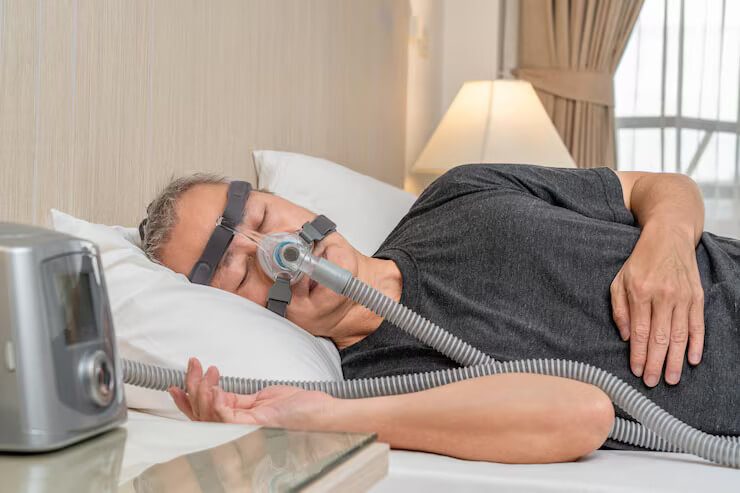
A Proper Sleep Study Measures:
Airflow at the nose and mouth
Chest and abdominal movement
Blood oxygen levels with a medical-grade pulse oximeter
Brain waves (EEG)
Eye movement (EOG)
Muscle activity (EMG)
Heart rate and rhythm (ECG)
Body position
All of these parameters are interpreted by a sleep technologist and physician to arrive at an accurate diagnosis.
FDA Approval and Smartwatch Claims
Some smartwatches claim to be "FDA-cleared for sleep apnea detection"—but it is important to note:
This is not the same as "FDA approved for diagnosis"
Clearance is typically granted for "screening" purposes only, not "diagnosis"
A sleep study is still required to confirm a definitive diagnosis
The Risks of Relying Solely on a Smartwatch
Missed diagnosis: Severe sleep apnea that goes undetected by the smartwatch
Excessive anxiety: False positives cause unnecessary stress when no real problem exists
Delayed treatment: Assuming "I'm being monitored by my smartwatch, so I must be fine"
Insurance claims denied: A smartwatch-based diagnosis is not recognized by insurance providers
Resindo Medika: Accurate Medical Sleep Studies
If your smartwatch indicates a potential sleep issue, get a professional sleep study at Resindo Medika:
Full polysomnography covering all medical parameters
Home sleep test for convenience (using medical-grade equipment)
Results interpreted by a certified sleep specialist
Medically valid diagnosis accepted for insurance claims
Treatment recommendations based on accurate data
Contact Resindo Medika for a professional sleep study. A smartwatch is a screening tool, not a diagnostic device—don't put your health at risk based on inaccurate data.